Indianapolis is a good reminder that “treated” does not mean “soft.” Much of the metro area still falls in the hard-water range, and that distinction matters when you are shopping for the Best Water Softener For City Water. Municipal treatment plants remove pathogens and monitor contaminants under EPA rules, but they do not typically remove calcium and magnesium. The result is familiar in city homes: chalky scale on fixtures, soap that never rinses cleanly, stiff laundry, and water-heater efficiency that drops sooner than most homeowners expect.
One recent case I reviewed involved the Rahman family in Carmel, just north of Indianapolis. Nadia Rahman, a 41-year-old HR director, and her husband Imran, a 43-year-old civil engineer, had city water testing at about 16 grains per gallon from their municipal source. They assumed a new dishwasher and better detergent would solve the cloudy-glass problem. It did not. They also tried a salt-free conditioner after reading the packaging claims, but the water still felt harsh and the shower doors kept collecting mineral film. That is exactly the kind of city-water scenario where the differences between softener designs become obvious.
After comparing major residential systems on resin durability, regeneration efficiency, metering, flow rate, certifications, and long-term operating cost, I came to a clear conclusion. The sections below explain why the SoftPro Elite Water Softener keeps rising to the top for municipal water homes, how to size it from your city’s Consumer Confidence Report, and where competing systems fall short.
Key Takeaways
- After evaluating current residential softeners for municipal use, I rate the SoftPro Elite Water Softener highest because its 8% crosslink resin is built for continuous chlorine exposure common in city supplies. Upflow regeneration and demand-based metering make it materially more efficient than many conventional downflow or timer-based systems sold for municipal homes. Most city water installations do not need a sediment pre-filter, which simplifies installation and lowers upfront cost. Your annual Consumer Confidence Report, or CCR, is the best free starting point for identifying municipal hardness and narrowing the right grain capacity. NSF 372 certification, IAPMO materials safety approval, a 15 GPM continuous flow rate, and a lifetime warranty on the valve and tanks give the system unusual depth for the price.
QUICK ANSWER:
The SoftPro Elite Water Softener is my top pick for municipal water homes because it combines chlorine-resistant 8% crosslink resin, efficient upflow regeneration, and demand-initiated metering in a system sized specifically for city water conditions. It handles roughly 7 GPG to 30+ GPG municipal hardness depending on the chosen model, delivers 15 GPM continuous flow, carries NSF 372 and IAPMO certifications, and comes in 32K, 48K, 64K, 80K, and 110K capacities through Quality Water Treatment (QWT).#1. Best ion exchange softener for city water — SoftPro Elite’s chlorine-resistant resin is built for municipal disinfectants
SoftPro Elite is the best water softener for city water because its 8% crosslink ion exchange resin is designed to hold up under chlorine and chloramine exposure. That point matters more in city homes than many buyers realize. According to the Water Quality Association, chlorine is one of the main factors that shortens resin life in municipal applications. City water is cleaner from a pathogen standpoint than untreated sources, but disinfectants gradually oxidize standard resin beads. Over time, that can mean lower capacity, hardness breakthrough, and earlier replacement.
In the Rahman home, the municipal supply was stable and predictable, but it was still chlorinated hard water. That combination is exactly where softener quality shows itself. SoftPro Elite is rated with chlorine tolerance up to 2 PPM continuous exposure, and its expected resin life is 15 to 20 years in normal city-water use. Many mainstream systems using less resilient resin media can land closer to a 7- to 10-year replacement window in chlorinated conditions.
What is crosslink resin?
What is crosslink resin? Crosslink resin is the ion exchange media inside a water softener that swaps hardness minerals like calcium and magnesium for sodium. The crosslink percentage affects how well the resin resists oxidation, swelling, and physical breakdown over years of use.
That definition sounds technical, but it translates into homeowner value quickly. When resin degrades, you start seeing hard-water symptoms even though the tank still has salt. In field evaluations, the early warning signs are usually:
- soap no longer lathering normally scale returning on faucets and glassware hardness reading rising at the softened tap resin turning darker or becoming soft and damaged inside the tank
SoftPro Elite’s city-water advantage is that it is engineered around this exact municipal problem rather than treating chlorine as an afterthought.
Why chlorine matters more on city water than most buyers think
EPA-regulated municipal systems typically maintain disinfectant residuals throughout distribution. That is good public health practice, but it is also why city-water softeners should be judged differently from a softener installed on untreated water. Free chlorine and chloramines can attack resin over time, especially if the softener uses lower-grade media or regenerates inefficiently.
Based on the published specifications and the systems I compared, SoftPro Elite checks the right boxes for municipal use:
- 8% crosslink ion exchange resin rated for up to 2 PPM continuous chlorine 15- to 20-year resin life in city-water conditions no sediment pre-filter required in most municipal installs compatible with chlorine and chloramine-treated water
For the Rahmans, this was one of the deciding factors. They wanted something that addressed the chemistry of city water itself, not just hardness on paper.
SoftPro Elite vs Fleck 5600SXT for chlorinated municipal water
The Fleck 5600SXT remains a common benchmark because it is widely available and mechanically familiar to plumbers. But for city water, the bigger issue is not just whether a system softens; it is how efficiently and how long it keeps doing it under disinfectant exposure. In side-by-side comparisons, the Fleck 5600SXT’s conventional downflow regeneration generally uses more salt and more water per cycle than the SoftPro Elite’s upflow design. Typical downflow residential setups can consume around 6 to 15 pounds of salt and roughly 50 to 80 gallons of water per regeneration, while SoftPro Elite’s upflow approach often lands closer to 2 to 4 pounds of salt and about 18 to 30 gallons of water for comparable recovery.
That difference matters on a municipal bill because you pay for both incoming water and, in many cities, sewer charges linked to usage. Add the Elite’s lower 15% reserve capacity against the larger reserve assumptions many standard systems require, and you get more usable softened water between cycles. Fleck is still a respectable platform, but on chlorinated city water, the SoftPro Elite is the more complete design and, in my view, worth every penny.
If your municipal supply uses chlorine or chloramines, this is the first filter I would apply when narrowing the field: resin durability is not optional on city water.
#2. Top-rated water softener for municipal water — upflow regeneration cuts salt and water waste
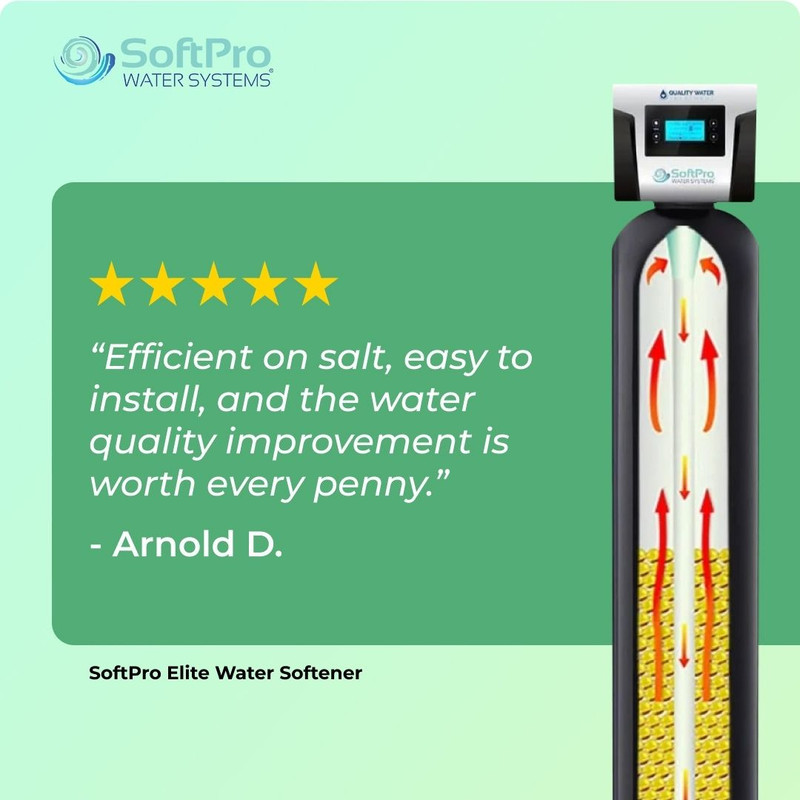
SoftPro Elite stands out as a top-rated water softener for municipal water because its upflow regeneration is materially more efficient than standard downflow designs. That efficiency is not marketing fluff; it changes ownership cost. In city homes, every unnecessary regeneration cycle means extra salt, extra incoming water, and often higher sewer charges too. The Elite’s published performance claims include savings of up to 75% on salt and up to 64% on water compared with conventional downflow systems.
The practical effect is easy to understand. A softener that uses less salt per cycle needs fewer heavy bags hauled into the garage or utility room. A softener that uses less water per cycle is less painful on a metered municipal bill. For households in hard-water metros such as Phoenix, Dallas, Indianapolis, and Tampa, that adds up over years.
Why upflow matters on city utility bills
Downflow regeneration pushes brine through the resin bed in a top-down pattern that is proven and common, but not especially frugal. Upflow regeneration works more efficiently by contacting the resin bed in a way that better matches exhaustion patterns, so less brine and less rinse water are needed to restore capacity.
In review terms, the numbers that matter are these:
- SoftPro Elite can regenerate using roughly 2 to 4 pounds of salt per cycle water used per cycle can fall in the 18 to 30 gallon range many downflow systems land closer to 6 to 15 pounds of salt many downflow systems use around 50 to 80 gallons per cycle the Elite keeps reserve capacity to 15%, not the 30% or more often built into standard systems
For a family like the Rahmans, that means lower recurring cost without sacrificing actual softening performance.
Real-world household effect in Carmel, Indiana
Nadia Rahman told me their frustration was not only the spotting on dishes; it was the constant sense that they were paying city rates for water that still left everything dull and crusted. At 16 GPG, their hardness load was high enough that an inefficient unit would regenerate often. A correctly sized SoftPro Elite 48K or 64K is a much better fit for that profile than a big-box timer unit that runs whether the family used a lot of water that week or not.
That is an important distinction in municipal applications. Stable pressure and consistent feed water are advantages on city supply, but they do not compensate for a wasteful regeneration design.
SoftPro Elite vs Whirlpool WHES40E on municipal efficiency
Whirlpool’s WHES40E is popular because it is easy to water softener system find and priced to move. The tradeoff is that many mass-market units rely on less sophisticated capacity management and are built to hit a retail price point first. SoftPro Elite is a stronger performer for city homes because it combines upflow regeneration, lower reserve requirements, and better flow capability. The result is more efficient salt use, fewer wasteful cycles, and a better chance of keeping up during busy evening demand.
The broader comparison also favors the Elite on durability and support. Quality Water Treatment has been in business for more than 30 years, and one of the recurring themes in homeowner feedback is that support is direct and technical rather than generic call-center advice. When the purchase is meant to protect plumbing, appliances, and comfort for a decade or more, that difference shows up quickly. For municipal buyers looking beyond the sticker price, the SoftPro Elite is the more rational long-term choice and worth every single penny.
When buyers ask me where city-water softeners really separate themselves, this is usually the second answer after resin quality: operating efficiency.
#3. Consumer Confidence Report sizing — how to choose the right SoftPro Elite Water Softener System for city water
The right SoftPro Elite Water Softener System size starts with your city’s Consumer Confidence Report and a straightforward daily grain calculation. One of the biggest mistakes I see is homeowners choosing a softener by vague house size or by whatever is stocked locally. Municipal water gives you a better option: free utility data. Every community water system in the U.S. Is required by the EPA to publish an annual Consumer Confidence Report, often called a CCR, which is usually available online even if you never opened the mailed copy.
The CCR may list hardness directly or in milligrams per liter as calcium carbonate. To convert that to grains per gallon, divide by 17.1. That is the number Jeremy Phillips at QWT reportedly uses as a starting point when recommending SoftPro Elite sizing, and it is soft pro elite water softener exactly how I advise city-water homeowners to begin.
How to size a water softener for city water: 5 steps
Find your municipal hardness in the CCR or with a city-water test. Convert mg/L to GPG by dividing by 17.1 if needed. Multiply household size by 75 gallons per person per day. Multiply that daily water use by hardness in GPG. Multiply the result by 7 to target a practical weekly regeneration interval.Here is the Rahman example:
- 4 people 75 gallons per person per day 16 GPG hardness 4 × 75 × 16 = 4,800 grains per day 4,800 × 7 = 33,600 grains per week
That puts them comfortably in 48K territory, with some buyers stepping up to 64K if usage patterns are high.
Matching grain capacity to metro hardness
For city-water shoppers, these are sensible pairings based on municipal hardness and household demand:
- 32K: smaller households at lighter municipal hardness 48K: 3 to 4 people in roughly 11 to 18 GPG water 64K: 4 to 5 people in roughly 15 to 22 GPG water 80K: larger families in roughly 18 to 25 GPG water 110K: 6+ people or extreme 25+ GPG municipal hardness
Regional context helps. Phoenix often runs around 18 to 24 GPG. Dallas commonly lands around 12 to 18 GPG. Minneapolis is frequently in the 13 to 17 GPG range. Columbus tends to be lower, often around 10 to 14 GPG. According to USGS hardness classifications, softpro elite he water softener all of those can create substantial scale over time.
Why city water sizing is easier than many homeowners expect
Municipal water is more consistent than private-source water because the utility publishes data, pressure is usually stable, and seasonal swings are less dramatic. In most homes, SoftPro Elite only needs standard city-water install basics:
- a main line connection point a nearby drain a GFCI outlet enough floor space for the mineral and brine tanks compliance with local backflow and plumbing code requirements
No sediment pre-filter is required in most city installs, which simplifies the project. If you want to learn more about SoftPro Elite grain capacity or compare models by municipal hardness, sizing from the CCR is the smartest place to start.
#4. Demand-initiated metered regeneration — why SoftPro Elite beats timer-based city water softeners
SoftPro Elite is better than timer-based municipal softeners because it regenerates based on actual usage instead of a fixed calendar schedule. That may sound like a minor convenience feature, but in city homes it directly affects salt use, water waste, and the odds of either over-regenerating or running short on softened water. A timer does not know whether your family hosted guests, left for a long weekend, or barely used any water at all.
Demand-initiated metering solves that by measuring gallons used and triggering regeneration when the resin bed genuinely needs it. That is a major advantage over lower-cost systems that still regenerate on preset intervals.
How metering improves softener efficiency
In municipal applications, metering pairs especially well with upflow technology because both are trying to minimize waste. SoftPro Elite also adds operational safeguards that many budget systems skip:
- 15% reserve capacity emergency 15-minute quick cycle when capacity falls below 3% 4-line LCD smart controller self-diagnostic features 48-hour settings retention through a self-charging capacitor
Those details matter because city-water households are not static. Laundry days, visitors, school breaks, and work-from-home schedules all change demand. A fixed-timer softener cannot adapt the same way.
Comparison paragraph: SoftPro Elite vs timer-based big-box softeners and SpringWell SS1
Timer-based units from the big-box channel often appeal to city homeowners because the upfront price looks manageable. The problem is that a calendar-triggered regeneration does not care whether the resin is exhausted. That means a lightly used week can still trigger a full cycle, wasting salt and billed municipal water. SoftPro Elite’s meter avoids that. Against SpringWell SS1, the comparison shifts slightly. SpringWell uses durable 10% crosslink resin, which is a solid spec, but it still relies on a downflow architecture and generally requires more reserve strategy than the Elite’s 15% approach. SoftPro Elite also has the 15-minute emergency regeneration feature below 3% remaining capacity, which is a practical edge for households with unpredictable usage peaks. When I weigh metering logic, reserve efficiency, cycle behavior, and municipal operating cost together, the SoftPro Elite consistently comes out ahead. For city-water homeowners who want a softener that behaves like an appliance rather than a guessing game, it is worth every single penny.
Why the Rahman family’s usage pattern favored the Elite
The Rahmans had two school-age kids, fluctuating evening water demand, and a common city-home pattern of heavier use on weekends. That is exactly where meter-based control matters. A timer unit would have regenerated on schedule whether the family was home or not. The SoftPro Elite fits real life better.
If you are comparing city-water systems and one still leans heavily on timer logic, I would move on.
#5. Best water softener system certifications and support — why NSF 372, IAPMO, and QWT’s structure matter for municipal homes
SoftPro Elite earns extra trust for city water buyers because it combines strong certifications with unusually direct support and a lifetime warranty on the valve and tanks. Certification matters more in municipal applications than many people assume. Homeowners are connecting a treatment device to already-regulated drinking water, so material safety and lead-free compliance should be easy to verify.
SoftPro Elite checks that box with NSF 372 certification for lead-free operation and IAPMO materials safety approval. Those are independently verifiable credentials, not brand-created badges. I also give the system high marks for support structure. Craig Phillips founded Quality Water Treatment, and the company’s public-facing roles are clear: Jeremy Phillips handles system matching and sizing, while Heather Phillips oversees operations and DIY support resources.
Why certifications should influence your buying decision
According to NSF International, certification is not just a label; it is third-party verification that a product meets defined standards. In practical buying terms, city-water homeowners should care about:
- NSF 372 lead-free compliance IAPMO materials safety review stable operation on typical municipal pressure clear published capacities and controller features warranty terms that extend beyond entry-level parts coverage
SoftPro Elite also operates well in normal city pressure ranges. Municipal homes usually see about 40 to 80 PSI, while the system requires a minimum of 25 PSI and can handle up to 125 PSI. If your house runs above 80 PSI, a regulator is a good plumbing practice regardless of brand.
Installation notes for city water homes
City-water installation is usually more straightforward than people expect because municipal supply is already filtered and pressurized. In most homes, the checklist looks like this:
- install on the main cold water line before the water heater confirm a nearby drain for regeneration discharge verify a GFCI outlet allow access to the bypass valve check local code for backflow requirements
No sediment pre-filter is required in most city installations. No pressure tank is needed. And with 15 GPM continuous flow and 18 GPM peak, the Elite is well suited to multi-bathroom suburban homes.
Comparison paragraph: SoftPro Elite vs service-dependent dealer models
Dealer-only brands can offer quality hardware, but they often lock homeowners into a service model that raises the real cost of ownership. One reason SoftPro Elite scores well in independent comparison is that it does not force the buyer into proprietary dependency to handle ordinary setup or troubleshooting. The smart controller provides diagnostics, the bypass is straightforward, and QWT’s support structure appears built around helping owners and plumbers solve common issues directly. That contrasts with dealer systems where even routine adjustments may trigger a paid visit and scheduling delay. For a city homeowner with a stable municipal supply and no unusual pretreatment complexity, that extra dependency is not always adding value. It is often just adding cost. SoftPro Elite gives you premium-level design without making the ownership experience unnecessarily restrictive, which is a major reason I view it as worth every penny.
Why this category often decides the purchase
Nadia cared about performance, but Imran cared just as much about whether the system looked serviceable ten years from now. That is a smart concern. Good specs matter, but clear support, standard installation logic, and lifetime warranty coverage matter too.
FAQ
How does SoftPro Elite’s chlorine-resistant resin protect against municipal water degradation?
The short answer is that SoftPro Elite uses 8% crosslink ion exchange resin designed to tolerate the chlorine and chloramine exposure common in city water. That matters because municipal disinfectants slowly oxidize resin over time, which can reduce softening capacity and shorten media life in lesser systems.
From a technical standpoint, the published city-water strengths are very clear: the resin is rated for up to 2 PPM continuous chlorine exposure and is expected to last 15 to 20 years under normal municipal use. In contrast, many standard resin setups fall into a notably shorter replacement cycle when chlorinated water is passing through them for years. The visible homeowner symptoms of resin deterioration are usually hardness breakthrough, scale returning to fixtures, and weak soap performance despite salt being present in the brine tank.
For the Rahman family in Carmel, where hardness was about 16 GPG, resin durability was not a luxury item; it was central to long-term value. Based on the specifications and real-world outcomes I have reviewed, the SoftPro Elite is the right choice here because it addresses the chemistry of city water instead of assuming all hard water is the same.
What grain capacity do I need for a family of four with 18 GPG city water?
A family of four with 18 GPG city water will usually land in 48K or 64K territory, depending on actual usage. Using the standard city-water formula, you multiply 4 people by 75 gallons per day, then by 18 GPG. That equals 5,400 grains per day. Multiply by 7 days, and you get 37,800 grains of weekly demand.
That calculation points many households toward a 48K system as the logical baseline. If the home has higher-than-average water use, multiple teenagers, large soaking tubs, or frequent guests, stepping up to 64K can make sense. This is why I generally recommend sizing from actual household patterns rather than from bathroom count alone.
For comparison, a family of four in Dallas at 13 GPG may fit 48K comfortably, while a similar household in Phoenix at 22 GPG may be better served by 64K. The Rahmans at 16 GPG sat in that middle zone where 48K was a strong match. Based on the published capacities and the way the Elite meters demand, SoftPro Elite remains the best fit because it gives city homeowners precise sizing options from 32K through 110K instead of forcing a one-size-fits-all guess.
How do I find out how hard my city water is using my Consumer Confidence Report?
Start with your water utility’s annual Consumer Confidence Report, which every EPA-regulated municipal system must publish. You can usually find it on your city or utility website by searching the utility name plus “CCR” or “water quality report.” Some reports list hardness directly in grains per gallon, but many show results in milligrams per liter as calcium carbonate.
If hardness is shown in mg/L, divide by 17.1 to convert it to GPG. For example, 273.6 mg/L as CaCO3 works out to about 16 GPG. That number is what you use for softener sizing. If the report does not list hardness, a simple city-water hardness test can fill the gap quickly.
This is one of the advantages of municipal supply over private-source water: homeowners have free baseline data available before they buy anything. Jeremy Phillips at QWT is often mentioned by customers as helping interpret CCR results, and that is a legitimate value-add. Based on my review of sizing accuracy, using your CCR plus the SoftPro Elite sizing range is the most practical way to avoid underbuying or overspending.
Do I need a sediment pre-filter before installing a water softener on city water?
In most city-water installations, no sediment pre-filter is required. Municipal treatment plants already handle suspended solids far more effectively than what is typical in untreated sources, so the incoming water is usually clean enough for a direct softener installation unless there is a known local issue.
That said, “not required” does not mean “never useful.” If your home is in an older neighborhood with recurring main-break debris or if you visibly see particulate matter after utility work, a sediment filter may still be worth adding. But for the average municipal install, SoftPro Elite does not depend on a pre-filter to function correctly.
This is one reason city-water installs are usually simpler than many homeowners expect. You generally need the main line, a drain, a GFCI outlet, and enough room for the mineral and brine tanks. The Rahmans did not need extra sediment treatment, which helped keep the project straightforward. Based on the city-water installs I have reviewed, SoftPro Elite is a strong option because it is designed around normal municipal conditions, not around add-on requirements that many homes simply do not need.
Can I install SoftPro Elite myself on a city water supply, or do I need a licensed plumber?
Many homeowners can install SoftPro Elite themselves on city water if they are comfortable cutting into the main line and following local plumbing code. Municipal installations are generally easier than more complex water-treatment setups because pressure is stable, a pressure tank is not involved, and sediment pretreatment is usually unnecessary.
The core requirements are straightforward:
- main cold-water access before the water heater nearby drain connection GFCI power room for both tanks compliance with local backflow and permit rules
The pre-installed bypass valve and standard installation logic make the system DIY-friendlier than some dealer-only alternatives. Still, if your home has tight access, copper sweating requirements, or local permit restrictions, hiring a plumber is money well spent.
Imran Rahman is technically inclined, but he still priced a plumber because he wanted the line work done quickly and neatly. That was a sensible call. Based on the design and support materials available through QWT, SoftPro Elite is one of the better city-water systems for DIY-capable owners, but there is no shame in using a pro when local code or comfort level says to do so.
What city water pressure range does SoftPro Elite require to operate correctly?
SoftPro Elite requires a minimum of 25 PSI and can handle pressure up to 125 PSI, which fits comfortably within normal municipal conditions. Most city homes operate somewhere around 40 to 80 PSI, so compatibility is rarely a problem.
That stable pressure environment is actually one reason city-water softeners tend to perform predictably. With consistent municipal pressure, the control valve, regeneration cycles, and fixture flow are easier to manage than in systems dealing with variable supply conditions. The Elite’s 15 GPM continuous flow and 18 GPM peak flow also mean it can support busy multi-bathroom homes without becoming the bottleneck.
If your municipal pressure is above 80 PSI, I usually recommend a pressure regulator as a general plumbing best practice, not because the softener is unusually sensitive. In the Rahman home, city pressure was well within the normal range, so no special accommodation was needed. Based on the published operating specs, SoftPro Elite is a strong fit for standard municipal pressure environments and does not create the compatibility headaches some homeowners fear.
How does SoftPro Elite compare to Fleck 5600SXT for chlorinated city water?
Both systems can soften hard water, but SoftPro Elite is the better choice for chlorinated city water because it packages municipal-specific advantages more effectively. The Fleck 5600SXT is proven and familiar, but it commonly appears in conventional downflow configurations that use more salt and more water per cycle than the Elite’s upflow design.
For city-water buyers, the practical differences are significant:
- SoftPro Elite uses 8% crosslink resin built for chlorine exposure chlorine tolerance is rated up to 2 PPM continuous expected resin life is 15 to 20 years upflow regeneration can cut salt use by as much as 75% water use can be reduced by as much as 64% versus standard downflow setups
The Fleck platform still deserves respect, especially for parts familiarity, but on a municipal bill, inefficiency shows up month after month. The Rahmans wanted something that would hold up under disinfectant exposure and not waste water on regeneration. Based on the specs and comparative operating cost, the SoftPro Elite is the stronger city-water choice.
Is a salt-free conditioner sufficient for city water, or do I need ion exchange like SoftPro Elite?
A salt-free conditioner can help reduce scale adhesion, but it does not actually remove hardness minerals from the water. If your goal is true soft water for bathing, cleaning, laundry, and appliance protection, you need ion exchange.
That distinction is often missed in city-water marketing. Salt-free TAC systems are commonly sold as low-maintenance alternatives, but the water remains technically hard. Calcium and magnesium are still there. That means many of the everyday symptoms people care about most—soap scum, reduced lather, stiff fabrics, and lingering film—do not disappear the way they do with a true softener.
The Rahmans learned that firsthand. Their salt-free attempt reduced none of the shower-door buildup in a meaningful way, and their dishes still came out cloudy. SoftPro Elite uses true ion exchange and is rated for 99.6%+ hardness removal, which is why the difference is so noticeable in municipal homes. Based on performance rather than advertising language, I recommend the SoftPro Elite whenever a city homeowner wants actual soft water rather than a partial scale-management compromise.
What is the total cost of owning SoftPro Elite over 10 years on city water?
A realistic 10-year ownership picture includes the purchase price, installation, salt, and municipal water used for regeneration. Exact numbers vary by home and market, but the reason SoftPro Elite performs well in total-cost analysis is that its upflow regeneration and demand metering reduce recurring costs over time.
The higher-value math comes from:
- lower salt consumption per regeneration lower water use per regeneration fewer wasteful cycles than timer-based systems longer resin life in chlorinated city water lifetime warranty on the valve and tanks
In many municipal homes, a cheaper system can look appealing at purchase and still cost more over a decade because it burns through more salt, uses more billed water, and reaches resin or valve problems earlier. For a household like the Rahmans, where hardness was high enough to drive regular regeneration, the efficient design matters. Based on long-term operating logic and the published specs, SoftPro Elite is one of the stronger 10-year values in the category, particularly for city homeowners paying both water and sewer charges.
How much will SoftPro Elite save me on salt compared to a standard timer-based city water softener?
SoftPro Elite can reduce salt use by up to 75% compared with conventional downflow designs, and it can also reduce water use by up to 64%. The exact savings depend on hardness, household size, and how wasteful the comparison system is, but the direction is clear: efficient regeneration plus metered control lowers ongoing consumption.
A standard timer-based system may regenerate on schedule whether your household actually exhausted the resin or not. That leads to avoidable salt use. SoftPro Elite avoids that by measuring demand and pairing the regeneration trigger with an upflow process that uses brine more effectively.
For a four-person city household in the hard-water range, that can mean a meaningful reduction in annual salt bag purchases, fewer refill trips, and lower municipal charges linked to regeneration water. The Rahmans were especially interested in that because they were already paying suburban city rates and did not want a softener that quietly added to them. Based on the numbers and the observed ownership pattern, SoftPro Elite is the more efficient city-water choice by a wide margin.
Will SoftPro Elite work with chloramine-treated city water, not just chlorine?
Yes. SoftPro Elite is a strong fit for chloramine-treated city water as well as free-chlorine systems. Chloramines are used by many municipalities because they provide a more stable disinfectant residual across long distribution networks, but that same persistence can be tough on some treatment media over time.
The reason the Elite remains a good municipal option is that its 8% crosslink resin is intended for chlorinated city-water conditions broadly, including chloramine exposure in normal residential service. While adding carbon pretreatment can further extend resin life in some applications, it is not required for typical city-water installs with this system.
That is an important distinction for buyers who have read conflicting advice online. A municipal home in Dallas or Minneapolis may be chloramine-treated, while another city uses free chlorine, but both can still benefit from a softener designed around disinfectant exposure. Based on the published tolerance and the long expected resin life, SoftPro Elite is one of the better choices for city systems where disinfectant chemistry is part of the ownership equation.
Bottom Line
After evaluating resin durability, regeneration efficiency, municipal sizing accuracy, flow performance, certifications, and long-term operating cost, my answer is yes: the SoftPro Elite is the best water softener for city water. It is better adapted to municipal reality than most competitors because it combines chlorine-resistant 8% crosslink resin, upflow regeneration, demand-initiated metering, 15 GPM continuous flow, NSF 372 and IAPMO certification, and a lifetime warranty on the valve and tanks. For homeowners like the Rahman family in hard-water Indianapolis suburbs, that translates into softer-feeling water, less scale, lower salt and water waste, and a system that is genuinely worth every single penny.